Showing posts with label Seitan. Show all posts

Thursday, September 2, 2010

Tabouli, anyone?


I'm not sure how many batches of tabouli I've made this summer. Five or six, maybe? I've used more than 2 pounds of bulgur wheat and made plenty of trips to raid my neighbor's mint plant, and my poor parsley plant (which is still alive!) gets frequent haircuts. I don't know why I've been wanting so much tabouli, but I can't get enough of it.

If you want to try making tabouli, this is the time to do it. Pretty soon, tomatoes and cucumbers and parsley and mint will go out of season, which means paying more $$$ for lower-quality produce. Unless you live in the Southern Hemisphere, of course...

I made another trip to the store where I get my whole grains, and I got oat flour, kamut (which I'm excited to try), lots of oats, and vital wheat gluten (the easy way to make seitan). More recipes coming soon!

Monday, August 2, 2010

Nutty Quinoa Salad and Seitan Cutlets

I got quinoa last week, mainly because it was a complete protein, and I've been wondering what to do with it. Last night I looked it up in The New Basics Cookbook, which is a fantastic cookbook that I think everyone should have. It describes all the vegetables, grains, types of rice, etc, and how to cook them and what they're best used for. Anyway, it had a recipe for Nutty Quinoa Salad, and it looked good, so I decided to try it.

When I opened the quinoa, it smelled a little strange, so I decided it would be a good idea to rinse it--except that it was too small and would go through the holes in my colander. So I lined a bowl with a clean dishrag, put in the quinoa, then the water, and then lifted the quinoa out using the dishcloth. Rinse and repeat.


Then you cook the quinoa and water, add the raisins, and cook a bit more until the water's absorbed. My stove is a bit finicky about coming to a boil if the saucepan is big--after all, it's only a 6-inch burner--but it did pretty well. It took a little longer than the recipe, but that's normal. Then it looks like this:


It said to remove from the heat and spread it in a thin layer on a baking sheet to cool. I completely disregarded this instruction, because I didn't want to have to wash the baking sheet, and I had nowhere to put the baking sheet anyway. So I put it in a bowl and added the green onions (so they would cook a little with the steam). Pretty soon I learned why they want you to spread it out: otherwise, it sticks together in a big glob. That's okay by me. After all, it's The Modest Kitchen.

I started in on the Seitan Cutlets, which I made like the Chicken Cutlets Mom used to make. I was a little dubious about the lump of seitan I was using, because it had been in the fridge a few days, but I tried a little bit and it tasted all right, so I kept going. I sliced the seitan:
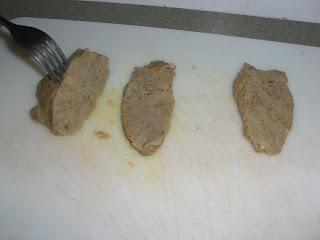
 

Then I dipped the slices in egg and bread crumbs and sauteed them in the pan.


When I was done, I didn't want to waste the egg, and it hadn't been contaminated by raw chicken or anything, so I scrambled the leftover egg with some of the leftover breadcrumbs.


Back to the quinoa salad. I added the peanuts, mandarin oranges, and some toasted sesame oil. The recipe calls for regular sesame oil, but it wasn't available at either of the nearby grocery stores, except an extra-virgin sesame oil (???) that cost more than $8. I was planning to add some canola oil if I needed a little more oil, but I don't like oily food, and a couple of tablespoons of toasted sesame oil seemed like plenty.


Then I sat down for dinner, and I soon realized that I hadn't added the mint or the orange zest. I was too hungry to go back to food prep, so I just added a little mint and orange zest to the portion on my plate. The quinoa salad was good--it really tasted gourmet. Unfortunately, most of the seitan had gone bad. A couple of the slices tasted ok, but most of them tasted like chewy fish. Ick. The egg, however, was fantastic. I have to do that again sometime.

After dinner, I added the mint and orange zest to the rest of the salad. Here's the final version:


Nutty Quinoa Salad
from The New Basics Cookbook

1 cup quinoa
2 cups water
1/2 cup golden raisins
1/4 cup sesame oil (I used a tablespoon or two of toasted sesame oil)
3 green onions, white bulb and 3 inches green, sliced
1/2 cup unsalted roasted peanuts
1/2 cup canned mandarin orange sections, drained (I used an entire small can, because I didn't want to waste the leftovers)
2 tablespoons chopped fresh mint leaves (I used much less, probably 10-15 leaves)
2 teaspoons grated orange zest

1. Combine the quinoa and water in a large saucepan and bring to a boil. Reduce the heat, cover, and simmer for 10 minutes. Then add the raisins and continue cooking until all the liquid has evaporated, 5 minutes. Remove the pan from the heat and spread the mixture out on a baking sheet. Let it cool completely.

2. In a large bowl, combine the quinoa and raisins with all the remaining ingredients. Toss gently and serve.

4 to 6 portions


Seitan Cutlets

Egg(s)
Italian style bread crumbs
Sliced seitan
Oil

Put egg and breadcrumbs in separate bowls. Beat egg. Dip slices of seitan in egg and then breadcrumbs to coat.

I think this would have been good, if I hadn't used too-old seitan, and if I hadn't cooked the seitan too long when I first made it (see previous post about seitan). I'll chalk that up to experience and try again, because this really is promising.


Scrambled Egg(s) with Breadcrumbs

Scramble egg(s) as usual, but add Italian-style breadcrumbs when you add the egg. Yum.

Tuesday, July 27, 2010

Making Seitan

What a mess! (But it was a lot of fun.)

I've been reading a vegetarian cookbook lately--it's called 366 Healthful Ways to Cook Tofu and Other Meat Alternatives--and I came across something called seitan. It's a meat alternative with a decent amount of protein, and you can make it yourself pretty cheaply, and apparently it can substitute for meat so that people hardly notice. You can make things like Seitan Cutlets (like Chicken Cutlets--breaded and sauteed--but no chicken) or Seitan Bourguignon (like a beef stew). It seemed worth trying, so I set about making seitan this afternoon.

You start with wheat flour (I used 6 cups), and then you add a little less than half that amount of water, and make a ball of dough which you knead for 5 minutes. Don't flour and water make paste? That's what it felt like. It definitely wasn't like dough, so I'm not sure how you really knead it. Mostly I ended up squishing it through my fingers. I tried to scrape the last bits of dry flour out of the bottom of the bowl, but my hands were so coated with paste that I didn't have much success with that.

I would have taken a picture of the process, but if I had tried, I would have ruined the camera.

The next step was to run water over the dough, which also allowed me to get all the goop off my hands, and leave it alone (covered with water) for 15 minutes. Now it looked like this:


The 15-minute interlude gave me time to get out the stove and the pot . You fill the pot with water and add some seasonings. I didn't have most of what the book recommended, but I did have half an onion and half a clove of garlic, and I also added some soy sauce and a dash of powdered ginger to approximate what was recommended.

Back to the dough. You stick your hands in the water and start kneading (or squishing) the dough again. The water will turn white. When it does, you pour it down the drain, add more warm or cold water, and knead some more. Rinse and repeat until the water doesn't turn white any more. This took me about 20 minutes. As I kept doing this, the dough got stranger and stranger.

First it held together in a lump:


Then it started to look like brains:


Then it got too stringy to look like brains, and too stretchy to knead, so I had to pull it apart to knead it:


Finally I decided I was done and I drained the last bit of water. Now it's raw seitan:


Then I cut it into four pieces:


Apparently seitan should be poached right after you make it (cooked over low heat for an hour), and then you can cook it for whatever you want to use it for (or freeze it in liquid). I had the cooking liquid ready, so I turned the stove on. A few minutes later, I realized that it didn't do any good to turn the stove on when I hadn't plugged it in yet:


Finally I got the cooking water heated to almost boiling, added the raw seitan, put on the lid (not because of the recipe, but because my stove works better that way), and decided it was time for dinner. Leftovers!

After dinner I finally decided it had cooked enough, so I took it out of the pot:


Then I bagged it and left it out to cool, and later I'll put it in the freezer. Tomorrow I'll decide what I want to make with it.

I also started thinking about my poor sink. The kneading underwater process gets out the starch and bran from the dough, so a lot of starch and bran went down the drain. I really did try to wipe some of it out, but there was so much of it! I think I'll give the sink a dose of baking soda and vinegar tonight. That should clear out the drain, and besides, it's so fun to watch it bubble.